Sonoran Desert Corridor™ – 51 Corridor™
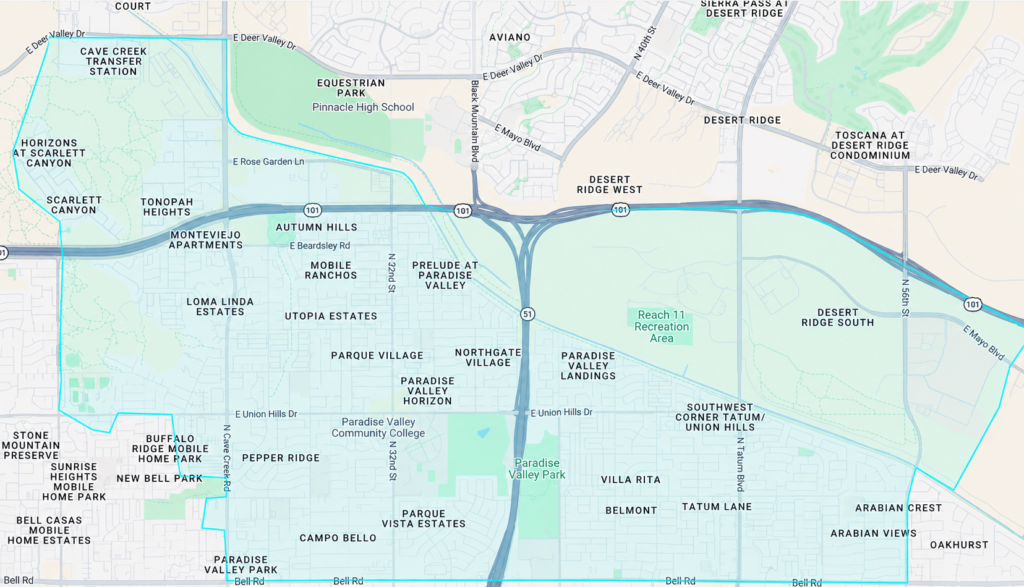
The 51 Corridor™ includes neighborhoods generally located along the State Route 51 corridor in North Phoenix, south of Loop 101 and north of Bell Road. I group these communities because they share similar commuting patterns, amenities, housing characteristics, and market activity.
This is one of Sonoran Desert Corridor™ market areas used in my North Phoenix real estate reports. The terms Up the Creek™, Down the Creek™, and 51 Corridor are market area designations created by Wayne Metcalf to describe the geographic areas covered by his market reports.
These market areas are unique to my market reports and are designed to provide consistent neighborhood comparisons over time.

An Established North Phoenix Market
Much of the 51 Corridor™ reflects Phoenix’s northward residential expansion during the 1960s and 1970s. The area extends from Bell Road north to Loop 101, generally between Cave Creek Road and Tatum Boulevard.
The Paradise Valley neighborhoods around 32nd Street and Paradise Valley Park make up a large part of the corridor’s older housing stock. Paradise Valley Oasis began developing in the early 1960s, followed by additional subdivisions including Loma Linda Estates and Utopia Estates through the 1960s and 1970s. Together, these established neighborhoods define much of the character of this part of North Phoenix.
Homes are generally smaller and sit on larger lots, although most are well under half an acre. Many were tract-built with brick, block or stone construction and three-tab or composition shingle roofs rather than the clay or concrete tile roofs that became common in later Phoenix development.
Front yards tend to be simpler and more established, with native desert plants, mature palms and landscaping that has evolved over decades. Many neighborhoods have no HOA.
A Mix of Housing Generations
The 1960s and 1970s homes remain the predominant housing pattern, but the housing mix changes as you move north and east through the corridor.
During the 1980s, newer subdivisions east of SR51 extending to 56th Street brought larger homes on somewhat smaller lots, along with increasing use of frame and stucco, rather than the previous block or brick. Around Union Hills, the later 1980s and 1990s subdivisions reflect more of the familiar North Phoenix pattern: larger homes, smaller lots, stucco exteriors, tile roofs and more HOAs. These later neighborhoods are mixed among the older housing rather than replacing it.
Paradise Valley Community College, which opened its permanent campus near 32nd Street and Union Hills in the 1980s, is another marker of the area’s continued northward development.
Manufactured Homes and Custom Pockets
Closer to Loop 101, several established 55+ manufactured-home communities also become part of the housing mix. In many of these communities, residents own the manufactured home while leasing the homesite. Manufactured homes on leased land may be legally attached to the real property through an Affidavit of Affixture. Near Cave Creek Road and Beardsley, just south of Loop 101, there is also a small pocket of older custom homes tucked into the rocky terrain east and west of Cave Creek Road. Over time, portions of this area have transitioned from earlier single-family housing to apartment and other multifamily development along the major roads.
Residential Neighborhoods Within a Working City
The 51 Corridor™ is not a collection of isolated master-planned communities. Residential neighborhoods often meet commercial properties and light industrial uses along the major streets.
Bell Road forms a natural southern boundary. It is one of North Phoenix’s major commercial corridors, with shopping, restaurants, services and increasingly multifamily development. The redevelopment of the former movie-theater property near 34th Way and Bell is one example of how land along the corridor continues to change.
A sizable number of single-family homes throughout the area are rental properties, mixed among long-term owner-occupied homes. On many streets, the difference is noticeable in landscaping and exterior upkeep, although pride of ownership remains evident throughout much of the corridor.
A Different Side of North Phoenix
The 51 Corridor™ offers a different housing environment from the newer communities farther north. The homes are older, the lots are often larger, HOAs are less common, and the neighborhoods reflect several decades of Phoenix growth rather than one period of development.
For buyers who value established neighborhoods, mature landscaping and a wider mix of housing styles, the 51 Corridor™ remains a distinct part of the North Phoenix market.
Interested in the 51 Corridor™?
Whether you are buying or selling, understanding how location, age, lot size, construction and neighborhood character affect value is important in this part of North Phoenix — and each subdivision here has its own story shaped by when it was built and how it’s evolved since.