More Choices, Same Affordability Problem
The most interesting part of the August Phoenix housing market was not simply that inventory increased. It was why it increased.
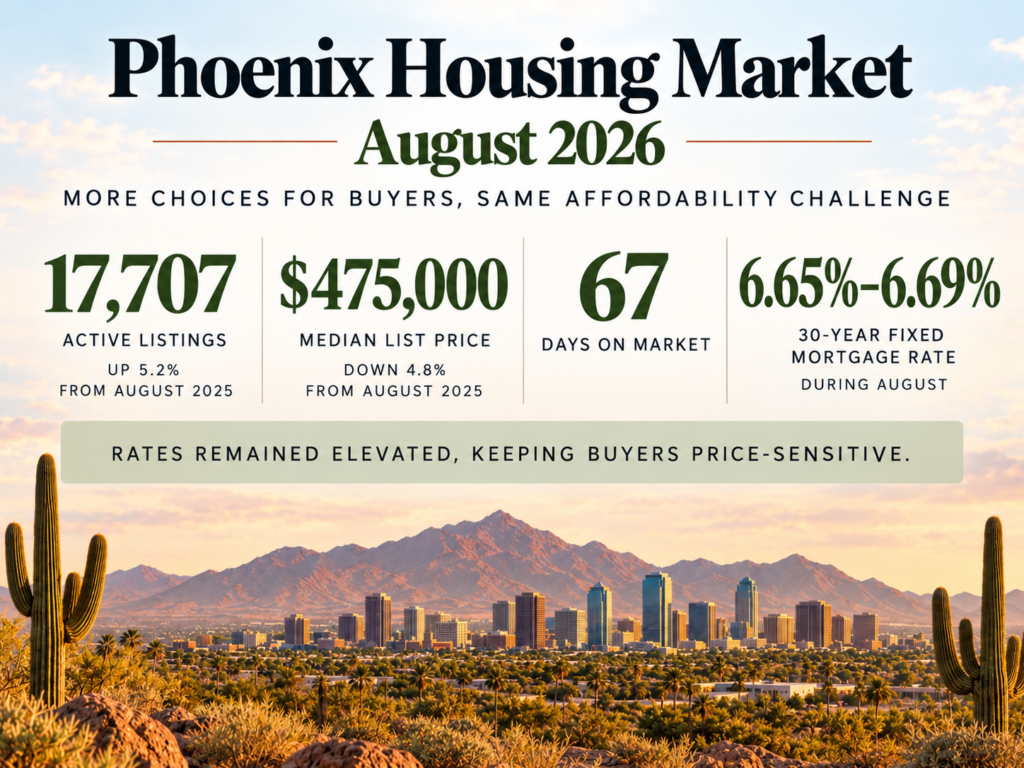
Phoenix had 17,707 active listings, 5.2% more than a year earlier, while new listings increased only 0.6%. That means most of the additional inventory was not created by a flood of new sellers. Homes were simply remaining on the market longer.
That tells us considerably more about buyer behavior than the inventory number by itself.
Buyers Had More Choices Because Homes Were Accumulating
When inventory rises because large numbers of owners suddenly decide to sell, that can signal one kind of market change. August looked different. New supply was almost unchanged from a year earlier, yet total active inventory increased because homes were not being absorbed quickly enough.
Buyers were still shopping, but they were taking their time and passing over homes that did not offer enough value.
So what? Sellers were not flooding the market. Buyers were simply becoming more selective about which listings deserved an offer.
Asking Prices Were Adjusting
The median Phoenix list price fell to approximately $475,000, down 4.8% from August 2025. Price reductions were also common, with about 27.6% of listings showing a price cut. More than one out of every four sellers had already adjusted the asking price.
That does not mean every home lost 4.8% of its value. Median list price reflects the mix of homes currently offered for sale; it is not an appraisal of an individual property. What it does show is that seller expectations were adjusting as buyers pushed back on prices.
Price reductions are usually the market correcting the original asking price, not the buyer suddenly discovering that the house is worth less.
Sixty-Seven Days on the Market Changes the Conversation
The typical Phoenix listing spent 67 days on the market in August. That was slightly faster than a year earlier, but still longer than the national median of 60 days.
More market time gives buyers more opportunity to compare homes and less reason to rush into an aggressive offer. It also gives sellers useful feedback. If comparable homes are attracting attention while one listing is not, the market may be saying something about the price.
The first few weeks remain especially important because waiting does not automatically improve an overpriced listing.
More market time rarely makes an overpriced home more attractive.
Mortgage Rates Did Not Give Buyers a Reason to Rush
Mortgage rates provided almost no relief during August. Freddie Mac reported the average 30-year fixed rate at 6.69% on August 6, 6.67% on August 13, 6.65% on August 20 and 6.66% on August 27.
Rates therefore spent essentially the entire month in the same narrow range. Buyers did not receive a meaningful affordability boost from lower financing costs, so there was little reason for them to stretch farther on price.
When rates remain elevated, even buyers who qualify for a larger mortgage may decide they simply do not want the payment.
Qualification tells a buyer what a lender will approve. It does not tell the buyer what payment will feel comfortable every month.
Why More Inventory Has Not Produced a Buying Rush
More choices normally benefit buyers, but supply is only one side of the equation. August buyers had more homes to choose from while borrowing remained expensive, and that combination encouraged comparison rather than urgency.
A buyer can look at several similar homes and ask a simple question: Which one gives me the most for the payment?That puts pressure on sellers whose homes are priced above comparable alternatives and rewards homes that are priced correctly and show well.
This is why the current market can seem contradictory. Some homes sell quickly while others sit. Some sellers negotiate while a well-priced property may still attract immediate interest.
The difference is often not whether buyers exist. It is whether buyers see enough value to act.
What August Means for Sellers
More inventory means every listing has competition. Before choosing a price, a seller needs to know not only what similar homes have sold for, but also what buyers can choose instead right now.
An active competing listing can matter almost as much as a closed sale because that is the property sitting beside yours on the buyer’s screen. Condition matters too. When two homes carry similar payments, buyers may become much less tolerant of deferred maintenance, dated finishes or obvious repairs.
In a market with choices, a home needs to justify both its price and its position against the competition.
What August Means for Buyers
August gave buyers something they have not always had in Phoenix: time. That does not mean every seller will accept a low offer, but buyers can compare alternatives, examine the numbers and negotiate where the property and market conditions support it.
Buyers should also look beyond the purchase price. A seller concession toward closing costs or an interest-rate buydown may sometimes provide more value than taking the same amount directly off the price.
When rates are the affordability problem, how the deal is structured can matter almost as much as the final sales price.
The August Takeaway
August was not a market collapsing under too much inventory. New listings barely increased. Instead, homes accumulated because buyers had choices, mortgage rates remained near 6.7% and buyers were willing to wait when the price did not make sense.
The clearest message from August is this: buyers have enough choice to walk past wishful pricing.