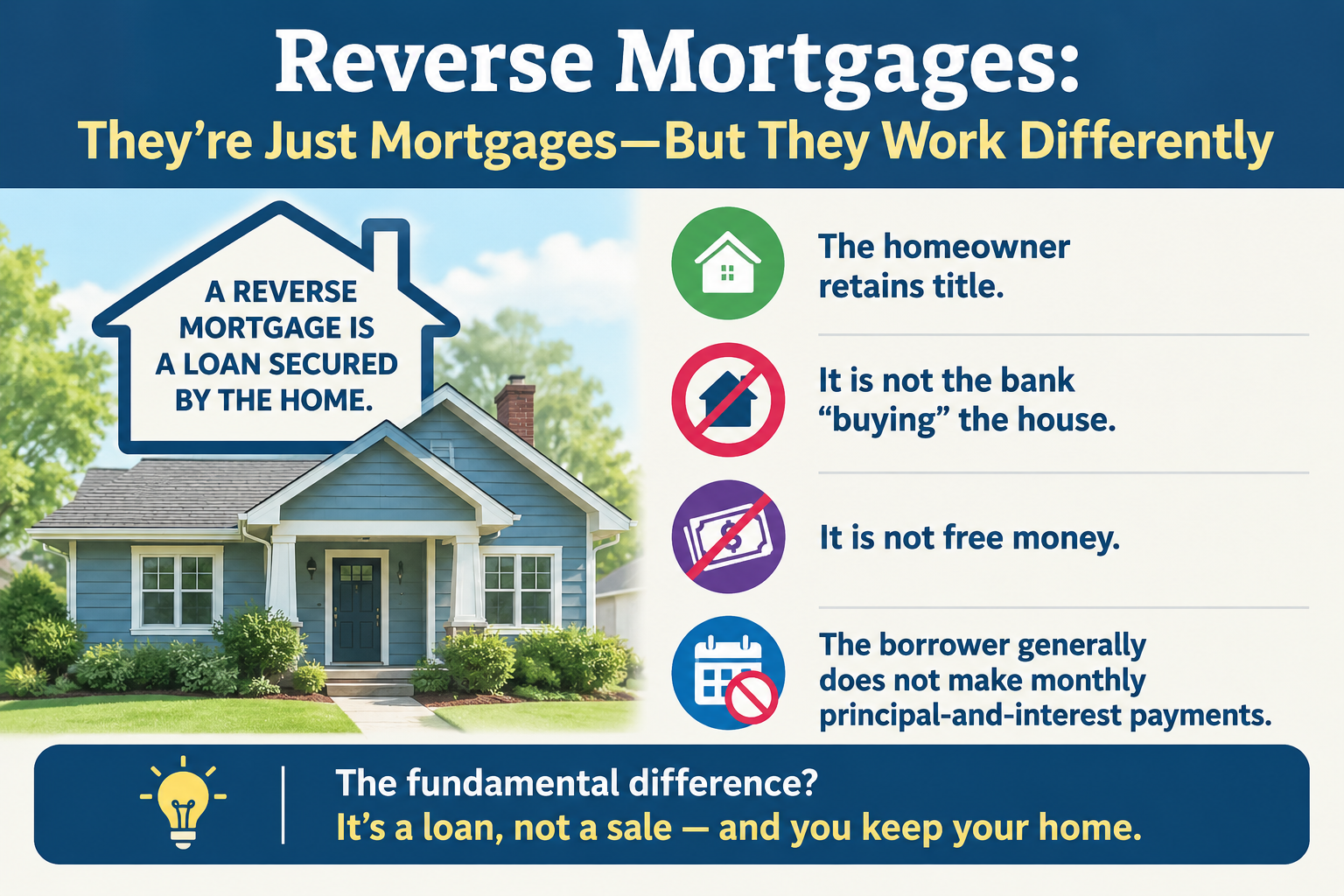
Reverse mortgages have a reputation for being complicated, risky, or even a way for the bank to take your house.
That is not how a reverse mortgage works.
A reverse mortgage is a loan secured by your home. You generally keep ownership of the home. The lender does not buy your house.
The biggest difference is how the loan gets paid back.
With a traditional mortgage, you make monthly payments and your loan balance usually gets smaller. With a reverse mortgage, you generally do not make required monthly principal-and-interest payments. Instead, interest and certain fees are added to the loan balance over time.
In simple terms, you are using some of the equity in your home now, instead of paying down a mortgage balance every month.
1. Start With the Basics
A mortgage is simply a loan that uses your home as collateral. The lender has a legal claim against the property if the loan is not repaid, but that does not mean the lender owns the house.
A reverse mortgage works the same basic way, but the money moves in the opposite direction.
Instead of you sending a monthly mortgage payment to the lender, the lender gives you money from the loan. You can receive that money in different ways, depending on the loan. It may be paid to you all at once, in monthly payments, or made available as a line of credit.
You generally do not have a required monthly principal-and-interest mortgage payment. But the loan is not free. Interest and other charges are added to the balance, so the amount owed generally grows over time.
That is the tradeoff: you get access to money from your home today, but you may have less equity in the home later.
Most reverse mortgages today are Home Equity Conversion Mortgages, commonly called HECMs. A HECM is insured by the Federal Housing Administration, or FHA, and is generally available to homeowners age 62 and older who meet the program requirements. Other types of reverse mortgages, including proprietary reverse mortgages, also exist.
The important point is that a reverse mortgage is still a mortgage. The difference is how you receive the money and how the balance changes over time.
2. Why Would Someone Want One?
One of the simplest ways to understand a reverse mortgage is to think about someone who is house-rich but cash-poor.
Imagine you own a $600,000 house and have very little money available in savings.
You have substantial equity, but most of that money is sitting inside the walls of your house. Selling the house would give you access to that equity, but then you would have to move. Selling investments is another option, but perhaps you would rather not. Or you could simply keep the house and live with a limited amount of available cash.
A reverse mortgage can provide another option for a qualifying homeowner.
It can allow you to access some of your home equity without selling the house. The money might be used for living expenses, home improvements, medical expenses, or simply to create more breathing room in the budget.
That does not automatically make a reverse mortgage the right answer. It simply means there is a financial tool that can turn some of the equity in your home into money you can use while you continue living there.
3. You Can Also Use One to Buy a Home
Reverse mortgages are not limited to people who already own their homes.
A qualifying older buyer can use a HECM for Purchase to buy a new principal residence.
Here’s a simple example.
Suppose someone sells a home in the Midwest for $250,000 and wants to buy a $500,000 home in Arizona.
With a traditional mortgage, the buyer might put down a certain amount and finance the rest, creating a monthly mortgage payment.
With a qualifying HECM for Purchase, the buyer can use the reverse mortgage to finance part of the purchase and provide the required remaining funds, along with applicable closing costs. The buyer can then generally live in the home without a required monthly principal-and-interest mortgage payment.
The exact amount the buyer would need to bring to closing depends on factors such as age, interest rates, the home’s value, the purchase price, and the program’s calculations. The $250,000 and $500,000 numbers are just an illustration of how the concept works.
The important idea is that a reverse mortgage can sometimes be used as part of a home purchase, not just as a way to pull equity out of a home you already own.
4. You Still Own the House
This is one of the biggest misunderstandings about reverse mortgages.
The bank does not simply get your house because you took out a reverse mortgage.
You generally retain title to the property. The lender has a lien against the house, just as a lender does with a traditional mortgage.
You can sell the home. When you sell, the reverse mortgage is generally paid off from the proceeds of the sale.
The loan also generally becomes due when the last borrower dies, permanently moves out of the home, or another event occurs that makes the loan due. There are also requirements involving property taxes, homeowners insurance, maintenance, and keeping the home as the borrower’s principal residence — meaning the home you actually live in most of the year, not a vacation home or rental. Certain protections can apply to an eligible surviving spouse.
What happens to the heirs is also often misunderstood.
If the borrowers die and the family wants to keep the house, the heirs generally have the opportunity to settle the loan and keep the property. If they do not want the house, it can generally be sold and the loan paid from the proceeds.
What If You Owe More Than the House Is Worth?
And there is an important protection with a federally insured HECM: it is a non-recourse loan.
That means the borrower or estate generally will not be personally responsible for a loan balance that exceeds the value of the home, subject to the program’s rules.
For example, suppose a HECM balance has grown to $400,000, but the house is worth only $350,000 when it is sold. The $50,000 difference does not become a personal debt owed by the borrower or estate under the HECM’s non-recourse protection.
The loan balance can be greater than the home’s value. But that does not mean the borrower or estate is required to come up with the difference.
That is also why an underwater HECM should not be confused with a traditional short sale. A short sale generally involves asking a lender to accept less than the amount owed on a traditional mortgage. With a HECM, the non-recourse structure is part of the loan itself.
5. What Does a Reverse Mortgage Actually Cost?
“No monthly mortgage payment” does not mean “no costs.”
The homeowner is still responsible for property taxes, homeowners insurance, required maintenance and repairs, and any applicable homeowners association dues.
There are also costs associated with the reverse mortgage itself. Depending on the loan, these can include origination costs, mortgage insurance, servicing charges, interest, and other closing costs.
Some costs may be financed into the loan rather than paid out of pocket. That still means they become part of what is owed.
This is important because the loan balance generally grows over time.
And if a homeowner fails to meet obligations such as paying property taxes or insurance, or fails to maintain the property as required, the loan can become due.
So the phrase “no monthly mortgage payment” needs to be understood correctly. It means you generally do not have to make the regular monthly principal-and-interest payment associated with a traditional mortgage. It does not mean you can stop paying the other costs of owning a home.
6. Is a Reverse Mortgage Worth Considering?
There is no universal answer.
A reverse mortgage may be something to investigate if you have substantial home equity but limited available cash, expect to remain in the home for a long time, or want another way to create more room in your retirement budget.
It may make less sense if you expect to move soon, want to preserve as much home equity as possible for your heirs, or cannot reliably keep up with property taxes, insurance, maintenance, and other homeownership costs.
And a reverse mortgage is not the only way to access home equity.
Depending on the situation, alternatives might include a traditional mortgage refinance, a home equity loan, a home equity line of credit (HELOC), selling and downsizing, using investment or retirement assets, buying a less expensive home, or considering other retirement-income strategies.
The right comparison is not simply, “Are reverse mortgages good or bad?”
A better question is: What problem are you trying to solve, and how does a reverse mortgage compare with your other options?
A reverse mortgage is a mortgage. It uses your home as collateral. You generally keep ownership. You generally do not make required monthly principal-and-interest payments, but the balance grows over time.
Understanding those basic facts makes it much easier to decide whether it is something worth investigating further.
Disclaimer — Information current as of September 1, 2026
This article is provided for general educational information only. It is not financial, legal, tax, or mortgage advice, and it should not be used as a substitute for advice specific to your situation.
Wayne Metcalf is a real estate agent and does not originate reverse mortgages or other mortgage loans and does not provide mortgage, financial, legal, or tax advice.
If you are considering a reverse mortgage, consult with a qualified reverse mortgage professional, financial planner, attorney, and certified public accountant (CPA) as appropriate to your circumstances.