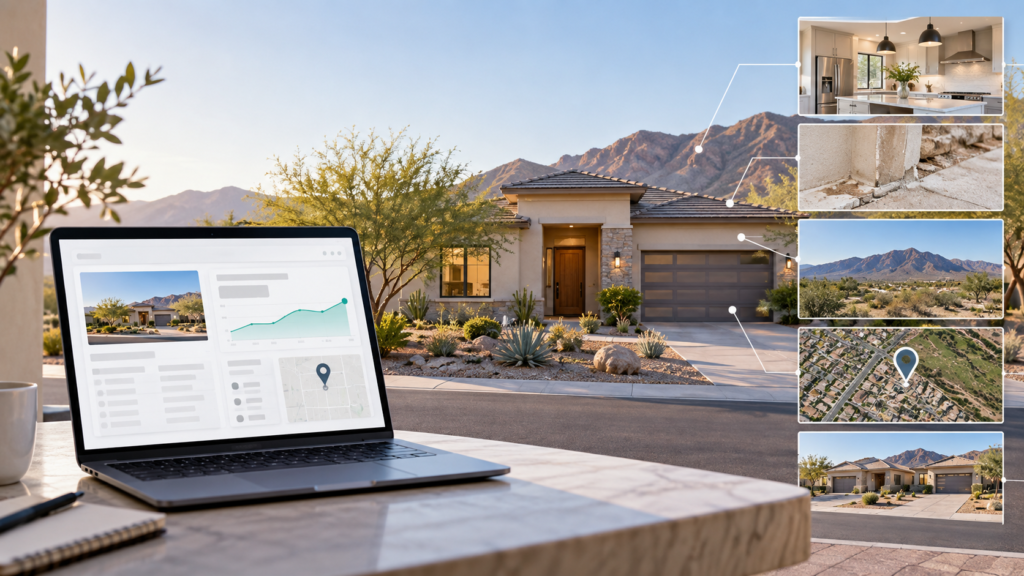
Online home valuations are easy to use. Enter an address, and within seconds a website produces an estimated value. That number can be useful as a starting point, but it can also be misleading.
Most online valuations are produced by a computer algorithm. The system analyzes property records, recent sales and other available data to estimate value. The problem is simple: the computer has never seen your home.
Online Home Valuation, Appraisal and Market Analysis
An online valuation is generated by a computer algorithm using available property data and recent sales. It can provide a quick estimate, but it does not necessarily verify the home’s condition or whether the sales used are truly comparable. An appraisal is a formal opinion of value prepared by a licensed or certified appraiser for a specific purpose, such as mortgage lending. The appraiser evaluates the property, researches comparable sales and market conditions, and makes adjustments for relevant differences.
A real estate market analysis serves a different purpose. It is prepared by a real estate professional to help a buyer or seller understand where a home fits in the current market. It considers comparable sales, current listings, condition, location and other factors that can influence what buyers are likely to pay. An appraisal answers what value is supported for its intended purpose. A market analysis helps answer how the home should compete in the current market.
An online estimate can be useful for quick reference, but it is not a substitute for either one.
An Online Valuation Does Not Know Your Home’s Condition
Public records may show square footage, lot size, bedrooms, bathrooms and prior sales, but they usually do not show the current condition of the home. An online valuation may not know that the kitchen was remodeled, the roof was replaced or the home has been exceptionally maintained. It may also miss deferred maintenance, worn finishes or improvements that buyers no longer consider desirable.
Two homes can look nearly identical in public records and sell for very different prices.
Nearby Homes Are Not Always Comparable Homes
Online valuation systems depend heavily on comparable sales. The challenge is choosing the right properties to compare. A nearby home may be in another subdivision, backing to a busy road, have a larger lot or offer features your home does not have. A single-story home may also compete differently from a two-story home.
Distance alone does not make a property comparable. The better question is:
Would a buyer considering your home also have considered that property?
If the answer is no, the sale may have limited value as a comparison.
Price Per Square Foot Can Be Misleading
Price per square foot is useful when similar homes are being compared. It becomes less useful when the homes differ. Lot size, condition, floor plan, garage space, views, pools and location can all affect what buyers will pay.
A smaller remodeled home can sell for more per square foot than a larger dated home. Applying the same price per square foot to both can produce the wrong value.
Online Valuations Can Miss Neighborhood Differences
Small location differences can create meaningful price differences. Two nearby subdivisions may attract different buyers, and even within the same subdivision, one street or lot may be more desirable than another. A home backing to open space may compete differently from one backing to a major road. A cul-de-sac lot may appeal differently from a property near a busy entrance.
An algorithm can identify some of these differences, but it may not understand how much buyers currently value them.
The Market May Have Changed
Closed sales tell us what happened in the recent past. Buyers are shopping in the market that exists today. Inventory may have increased. Sellers may be reducing prices. Homes may be taking longer to sell. Or limited inventory may give buyers fewer alternatives.
An online valuation may not fully reflect those changes until newer transactions close.
Improvements Do Not Add Value Dollar for Dollar
Homeowners often remember exactly what they spent improving a property, but buyers do not reimburse sellers for improvements. A $40,000 project does not automatically increase market value by $40,000. Some improvements add substantial value. Others improve marketability without returning their full cost.
The algorithm may not even know the improvement exists.
Buyers Compare Homes, Not Estimates
A buyer shopping for a home has choices. They compare your property with other homes available in their price range based on condition, location, features and price. If another home offers more value for the same money, the buyer may choose it instead.
Current listings matter because they show the alternatives competing for the same buyer.
Are Online Home Valuations Useless?
No. They can provide a quick estimate. They can also provide a general sense of market direction. The problem is treating the estimate as a precise value. For casual curiosity, an online valuation may be enough. When deciding whether to sell or how to price a home, it should be only one piece of information.
Practical Takeaway for Sellers
If you are thinking about selling, do not use an online valuation as your list price. Use it as one data point. Then compare it with recent sales, current competition and the actual condition and location of your home.
A price that is too high can reduce buyer interest and increase market time. A price that is too low can leave money on the table. The goal is not to match an algorithm. It is to price the home where buyers are most likely to respond.
What Is a Better Way to Estimate Market Value?
A useful market analysis starts with comparable sales but does not stop there. It also considers current listings, recent market activity, condition, lot, location, improvements and the choices buyers have today. The goal is to identify the price range the current market is most likely to support.
Online valuations estimate from available data. Market value depends on what buyers are willing to pay for your home compared with their other choices.