When the Federal Reserve changes interest rates, many people expect mortgage rates to move by the same amount. That sounds reasonable, but it isn’t how mortgage rates actually work.
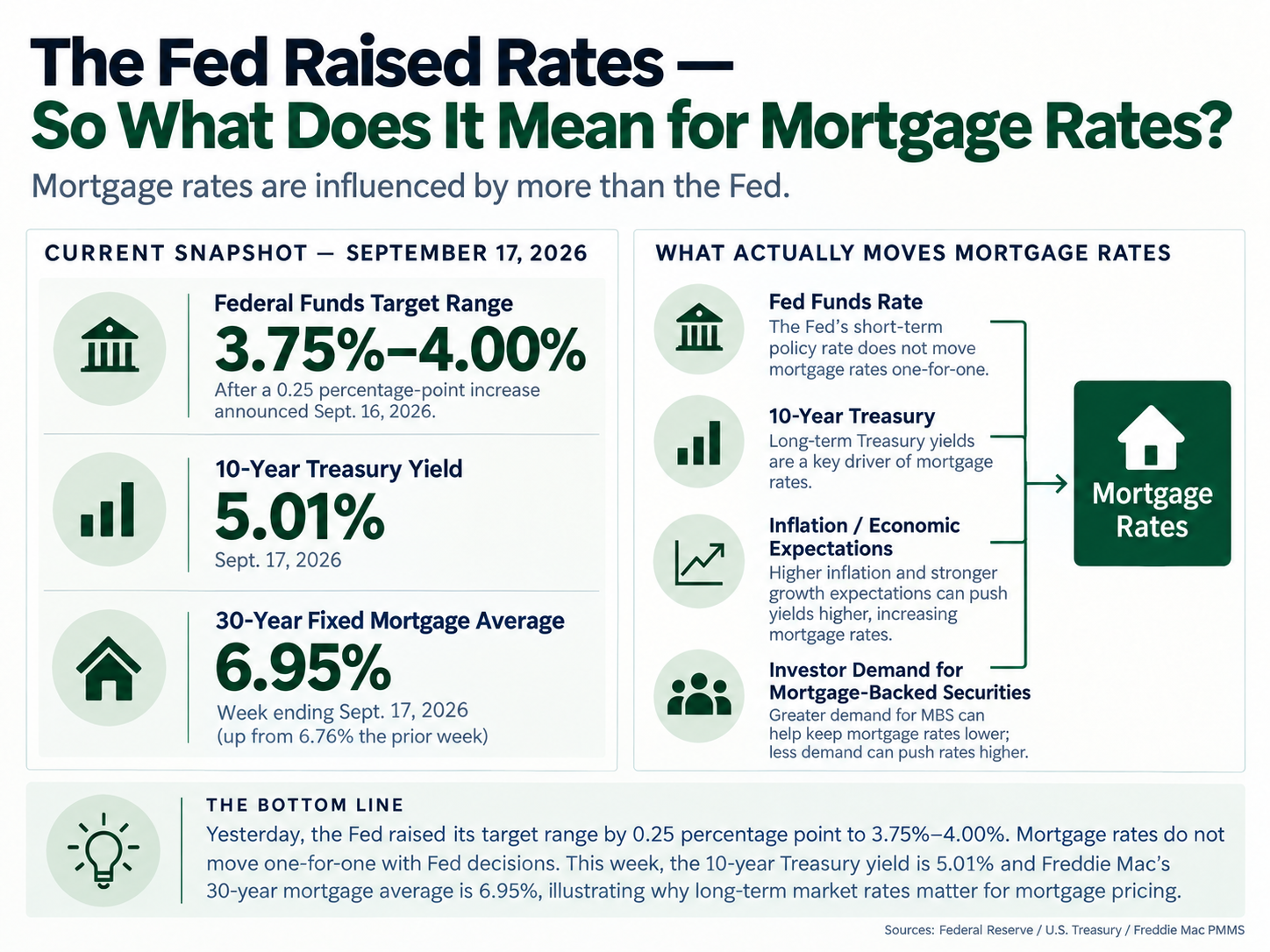
On September 16, the Federal Reserve raised the federal funds target rate by a quarter point, to a range of 3.75% to 4.00%. But that doesn’t mean 30-year mortgage rates automatically rise by a quarter point. The Fed doesn’t set mortgage rates directly.
What Rate Does the Federal Reserve Actually Control?
When the news says the Fed raised or lowered interest rates, it’s usually referring to the federal funds rate — a very short-term rate used for overnight lending between banks.
Changes in the federal funds rate can quickly affect borrowing tied closely to short-term rates, including some credit cards, home-equity lines of credit and variable-rate loans.
A 30-year fixed mortgage is different because it’s a long-term obligation. Investors buying mortgage-related securities care about what inflation, economic growth and interest rates may look like for years, not just what the Fed sets for overnight lending.
That’s why a quarter-point Fed change doesn’t automatically produce an equivalent change in mortgage rates.
What Actually Moves Mortgage Rates (Not the Fed)?
Mortgage rates are influenced heavily by the bond market, particularly longer-term U.S. Treasury yields and mortgage-backed securities. Investors are constantly weighing inflation, employment, economic growth, Federal Reserve policy and expectations about future interest rates.
Lenders price mortgages based on what those loans are worth in the financial markets, and that pricing changes every day as new economic information comes in.
That means mortgage rates can move even when the Fed has done nothing.
Why Does Everyone Watch the 10-Year Treasury?
The 10-year Treasury yield gets so much attention when mortgage rates come up because the two are influenced by similar long-term market forces.
They aren’t identical products, but the comparison still makes sense. A 30-year mortgage sounds far longer than a 10-year Treasury, but most homeowners don’t keep their mortgage anywhere close to 30 years. Homeowners refinance or sell and pay off the loan early, so the mortgage doesn’t usually remain outstanding for the full 30 years.
That’s why the 10-year Treasury is often used as a reference point when discussing the direction of mortgage rates, even though the two rates are not the same.
The Market Often Moves Before the Fed Does
Financial markets don’t wait for Federal Reserve officials to make an announcement. Investors are continuously trying to anticipate what the Fed is likely to do next.
If economic reports suggest inflation is rising or falling and investors adjust their expectations for future Fed policy, longer-term bond yields may begin moving before the Fed actually changes its policy rate. Mortgage rates can move along with them.
By the time the Fed announces a rate change, much of the expected change may already be reflected in financial markets.
The announcement may be new to the public, but it isn’t necessarily new information to investors. That’s why the Fed can change rates and mortgage rates can barely move — or even move in the opposite direction.
Mortgage Rates Can Move in the Opposite Direction From a Fed Rate Change
This isn’t just a theoretical possibility — it happened in 2024.
The Fed delivered a larger-than-usual half-point cut on September 18, 2024. Mortgage rates reached a two-year low of 6.08% the following week, but then reversed direction. Stronger economic data changed expectations for inflation and future Fed policy. The 30-year mortgage rate climbed through October and into November.
By November 7, when the Fed made its second cut of that cycle, Freddie Mac put the rate at 6.79%. Meaningfully higher than where it stood after the first cut.
Whats the theory
The lesson is that the market may react more strongly to what Fed officials signal about the future than to the rate change itself.
Yesterday’s rate increase makes the same point from the other direction. Mortgage rates had already been moving higher before the Fed’s announcement. Freddie Mac’s September 17 weekly survey showed the average 30-year fixed mortgage rate at 6.95%. Which was up from 6.76% the previous week. That survey is released weekly, so it should not be interpreted as a same-day reaction to yesterday’s Fed decision.
What This Means for Homebuyers
For a homebuyer, the number that matters isn’t the federal funds rate — it’s the mortgage rate actually available when they’re ready to purchase.
Even a relatively small change in mortgage rates can affect the monthly payment and how much house a buyer can comfortably afford.
But waiting for the next Fed meeting doesn’t guarantee a better mortgage rate. Mortgage rates can move substantially before the meeting takes place, and they can move in either direction afterward.
Trying to perfectly time a purchase around one Fed meeting is difficult because mortgage markets are already reacting to economic data and expectations.
A buyer is usually better served by understanding the payment at the rate available today, knowing what’s affordable, and evaluating whether a particular home makes financial sense now.
What This Means for Home Sellers
Mortgage rates matter to sellers because they directly affect buyer purchasing power.
Lower rates can improve affordability and bring buyers back into the market; higher rates can reduce how much buyers qualify to borrow or make the payment less comfortable.
But a Fed announcement doesn’t automatically change the housing market overnight.
Sellers still need to watch the factors buyers are actually responding to: current mortgage rates, competing homes, inventory, pricing and how quickly comparable properties are selling.
Locally, that means inventory levels and buyer competition in the Sonoran Desert Corridor™ can amplify or offset a national rate move. A well-priced home in a tight local market can still draw strong interest even when rates move higher.
The Bottom Line
The Federal Reserve influences interest rates, but it doesn’t set 30-year mortgage rates.
Mortgage rates are determined in financial markets that are constantly weighing inflation, economic conditions and expectations about future Fed policy. That’s why mortgage rates can move before a Fed decision, barely move after one, or move in the opposite direction.
Yesterday’s quarter-point Fed increase is a good example. The federal funds rate moved higher, but mortgage rates had already been moving higher before the announcement.
The better question isn’t simply, “What did the Fed do?”
It’s “What did the mortgage market do with the news?”
For buyers and sellers throughout the Sonoran Desert Corridor™, that’s what ultimately affects purchasing power, monthly payments and housing demand.