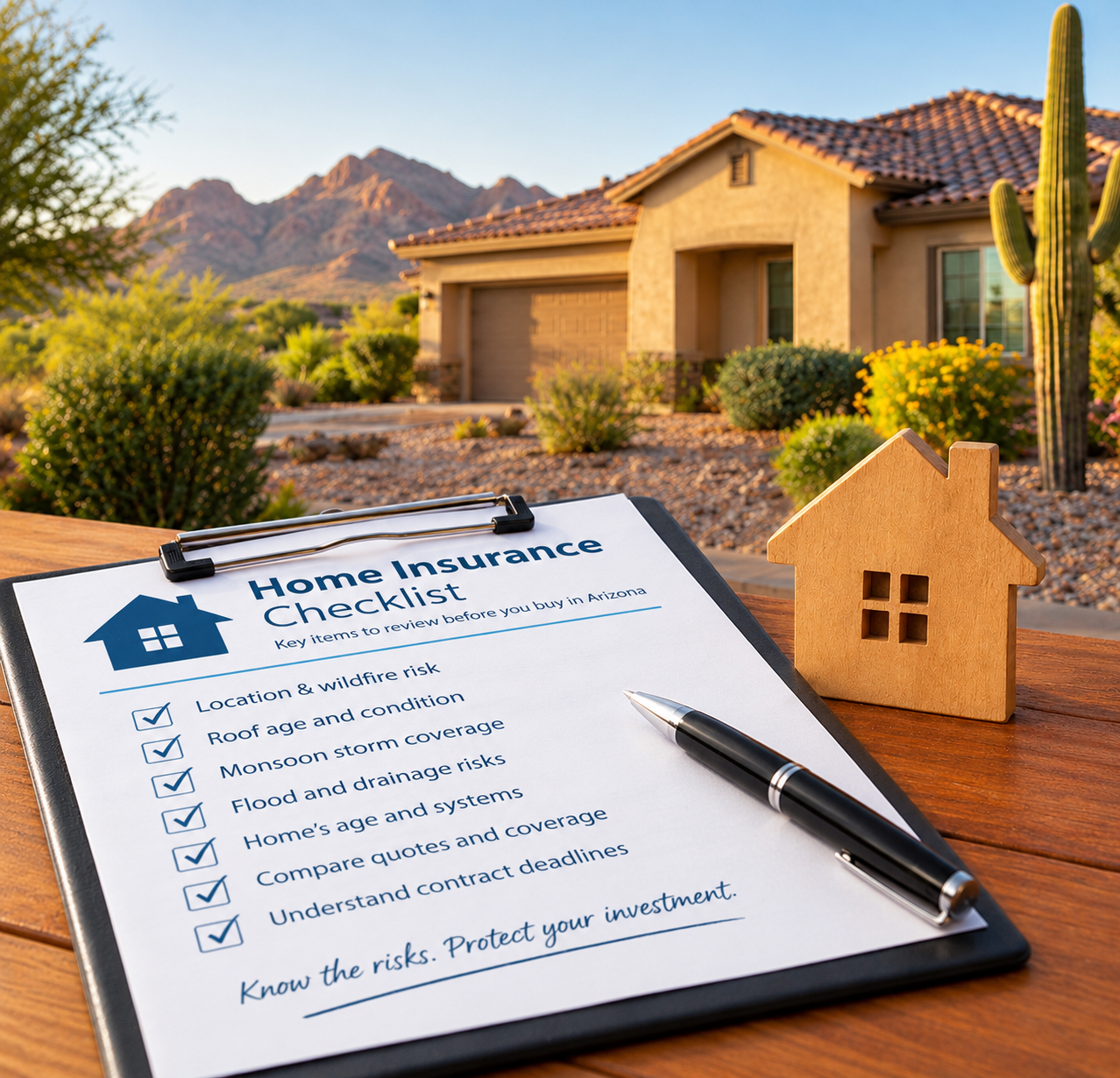
You’ve found a home you like, and you’re ready to make an offer. Before you commit, find out whether you can insure the property at a price you can afford. In Arizona, a home’s location, roof condition, wildfire exposure, and drainage risks can affect both insurance availability and cost.
A property that looks affordable on paper may become a different financial proposition once you factor in insurance. Here’s what to check before you commit.
What Could Make a Home Difficult or Expensive to Insure?
Insurance companies evaluate each property’s risks. Two homes in the same general area can receive very different quotes.
Wildfire exposure: Homes near forests, desert vegetation, or other areas with wildfire risk may face higher premiums or fewer insurance options. Some insurers limit the properties they will cover in higher-risk areas.
Roof age and condition: An older roof can concern insurers. Depending on the company, roof materials, and condition, you may face a higher premium, limited coverage, required repairs, or difficulty obtaining a policy.
Monsoon storms: Arizona’s summer storms can bring high winds and hail. Review how the policy covers storm damage, including deductibles, exclusions, and any conditions involving the roof.
Flood and drainage risks: Don’t rely solely on FEMA flood maps. Arizona washes and monsoon storms can create flooding and runoff risks, including outside mapped flood zones. Look for nearby washes, drainage channels, erosion, sediment deposits, water marks, or other signs that water may have crossed or collected on the property. Ask neighbors whether they have experienced flooding or runoff during heavy rains.
Standard homeowners insurance generally excludes flood damage. Ask your insurance agent whether separate flood coverage is appropriate. You can check a property’s mapped flood risk through FEMA’s Flood Map Service Center, but a map cannot identify every potential drainage problem.
The home’s age and systems: Older electrical systems, plumbing, and other features may raise underwriting concerns or lead to requirements that must be met before coverage is issued.
These factors don’t automatically make a home uninsurable. They do mean you shouldn’t assume that a property can be insured at a price comparable to other homes you’ve considered.
How Should You Shop for Coverage?
Start with the exact property address. Give the agent as much information as possible about the home, including its age, roof, construction, and any known condition or drainage concerns.
Consider working with an independent insurance agent who can compare options from multiple insurance companies. A captive agent represents a particular insurer, while an independent agent may have access to several companies. Neither arrangement guarantees the best price or coverage, but comparing options can help you make a more informed decision.
Ask the agent to explain:
- The annual premium and how it affects your monthly housing budget.
- The deductible, including any separate or percentage-based deductibles for certain types of damage.
- What the policy covers and excludes.
- Whether the roof, electrical system, plumbing, or other features require inspection, repairs, or additional documentation.
- Whether the quote is preliminary or subject to further underwriting approval.
Compare coverage, not just premiums. A cheaper policy may have a higher deductible, different exclusions, or less favorable terms. Make sure you understand what you would have to pay out of pocket after a loss.
A preliminary quote is not necessarily a guarantee that the insurer will issue the policy. Confirm that the company has reviewed the property and identify any outstanding conditions.
The Arizona Department of Insurance and Financial Institutions provides homeowners insurance information to help consumers understand coverage and compare options.
What Should You Check Before Your Contract Deadlines?
Getting quotes early is important, but so is understanding your purchase contract.
Your contract may provide specific rights and deadlines related to the property’s condition, insurance concerns, or other issues. Those provisions vary, and an expensive quote or an insurer’s refusal to provide coverage does not automatically give you the right to cancel without consequences.
Ask your real estate agent to identify the applicable deadlines and explain the steps required to preserve any rights available under your contract. If you are uncertain about your legal rights or the consequences of cancelling, consult an Arizona real estate attorney.
Start shopping for insurance early in the home inspection period. This gives you time to compare policies, provide requested information, and determine whether coverage is available at a price you can afford before your contract deadlines limit your options. If the property has an older roof or other potential insurance concerns, start as soon as possible.
Account for the Full Cost of Coverage
The premium is only part of the picture. Your deductible affects how much you would pay after a covered loss, so consider whether you could comfortably afford it.
If the property is in an HOA or condominium community, ask for information about the association’s master insurance policy. Find out what it covers, what deductibles apply, and what expenses could fall to individual owners. Condo buyers may need an HO-6 policy, while the appropriate coverage for other properties depends on the home and the association’s arrangements.
If separate flood insurance is appropriate, include that cost in your budget as well.
Homeowners insurance premiums are often included in the monthly mortgage payment through an escrow account. A higher premium can increase your monthly housing costs even though the purchase price hasn’t changed.
Check Before You Commit
Before making an offer—or while you still have time to evaluate the property—get insurance quotes for the specific home, compare coverage from multiple insurers, investigate potential drainage concerns, and understand your contract deadlines.
A home may still be worth buying if its insurance costs more than you expected. But you should know that before you commit, not after you’ve spent money on inspections and become emotionally invested in the purchase.
Don’t just ask whether you can afford to buy the home. Ask whether you can afford to own it, including the cost of insuring it.
Questions are welcome.