You’ve accepted an offer, agreed on a price, and started planning your move. Then the appraisal comes in low, and the buyer asks you to lower the price or help cover the difference. Before you decide whether to cut the price, challenge the appraisal, or risk losing the buyer, it helps to understand what a low appraisal means and what your agent should be doing about it.
Not Every Sale Requires an Appraisal
Not every home sale goes through an appraisal. If the buyer pays cash, no lender requires one, although the buyer may still order one on their own.
Some mortgage programs allow a lender to use an alternative valuation method or waive a traditional appraisal when the loan qualifies. A buyer may also waive an appraisal contingency in the purchase contract. These are different things, though. Waiving a contract contingency doesn’t automatically remove the lender’s requirement, and a lender may still order a valuation during underwriting.
For a seller, this means a waived appraisal doesn’t settle the price. Ask your agent early whether the buyer’s financing is likely to require an appraisal and what the contract says if the value comes in low.
Why an Appraisal Comes In Low
An appraisal estimates a property’s market value. The appraiser considers the home’s size, condition, location, features, and recent sales of comparable homes. The result isn’t always what the seller or buyer expects.
A low appraisal can have several causes. The agreed price may be higher than recent sales support. The market may have shifted, or the home may be hard to compare with others nearby. Sometimes the appraiser overlooks a relevant sale, misreads a feature, or makes an error in the report.
A low appraisal doesn’t automatically mean your price was wrong. It does mean you should understand how the appraiser reached the number before you decide what to do next.
Why a Low Appraisal Can Put Your Sale at Risk
The lender doesn’t base its loan only on the price you and the buyer agreed to. The appraised value and the buyer’s loan program help determine how much the lender will finance.
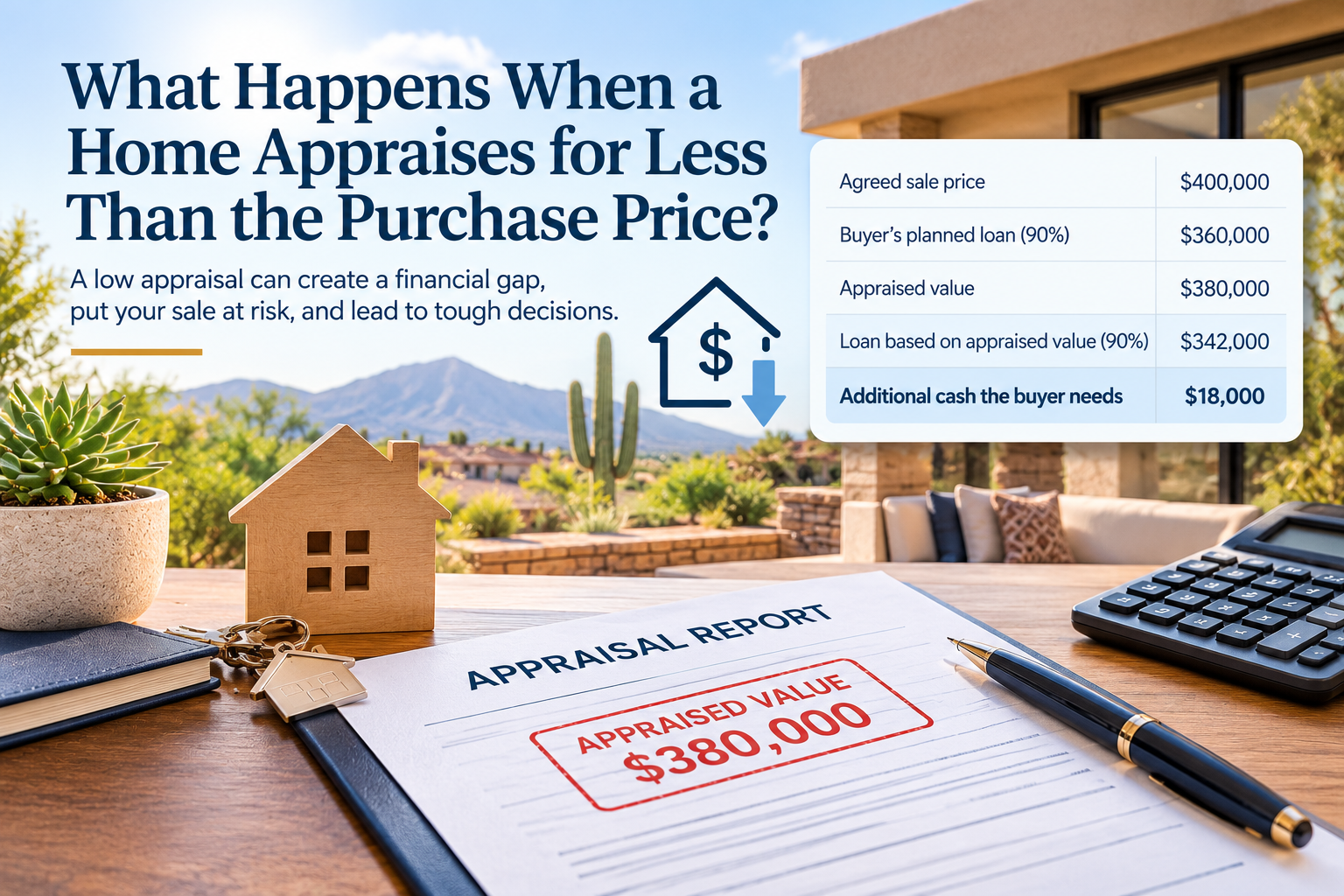
Suppose you agree to sell your home for $400,000, and the buyer plans to borrow 90% of that price, or $360,000. But the appraisal comes in at $380,000.
| Item | Amount |
|---|---|
| Agreed sale price | $400,000 |
| Buyer’s planned loan (90% of price) | $360,000 |
| Appraised value | $380,000 |
| Loan based on appraised value (90%) | $342,000 |
| Additional cash the buyer needs | $18,000 |
The buyer now needs to cover an additional $18,000 in cash, on top of any down payment and closing costs. This example assumes the lender calculates the loan at 90% of the lower value. Actual loan calculations depend on the loan program and lender.
If the buyer can’t cover the gap and you can’t agree on a solution, the sale may fall apart. You could lose the buyer, spend more months carrying the property, and face a lower offer later. A low appraisal can cost you more than the difference between the agreed price and the appraised value.
What a Good Listing Agent Does Before the Appraisal
Preparation starts well before the appraiser visits. A good listing agent analyzes recent sales of properties that are genuinely similar to yours in location, size, condition, features, and sale date. The agent doesn’t simply pick the highest-priced homes in the area.
The agent should also prepare a valuation packet for the appraiser. It can include the most relevant recent sales, a short explanation of why each one is comparable, the key differences between the homes, and documentation of improvements that affect value. The agent should also confirm that the property details, including square footage and features, are accurate before the report is written. Errors in that information can change the result.
Preparation doesn’t guarantee the appraiser will agree with your price. The appraiser must form an independent opinion. But a well-supported packet gives the appraiser a stronger basis for evaluating your home, and it lets your agent explain the asking price with evidence rather than opinion.
What You Can Do When the Appraisal Comes In Low
Start by reviewing the report rather than assuming it’s right or wrong. Your agent can compare the appraisal with the available sales and check whether the appraiser used relevant comparables, got the property details right, and accounted for important differences between your home and the comparables.
If the appraiser overlooked a relevant sale or made a material factual error, that may justify a review. The buyer generally works with the lender to pursue the review process, which may include a reconsideration of value (ROV) when the appraisal has identifiable deficiencies or relevant supporting information was overlooked. Your agent can help organize the supporting information and explain why specific sales matter, but your agent cannot tell the appraiser what value to use.
The process depends on the loan program and the lender. For official guidance, start with the applicable source:
- Conventional loans: Fannie Mae’s Reconsideration of Value guidance.
- FHA loans: HUD’s FHA Single Family Housing Policy Handbook 4000.1.
- VA loans: VA’s home-buying guidance.
Ask the buyer’s lender which review procedure applies, what information is needed, and what deadlines apply. A second appraisal isn’t automatically available just because the first value came in low. The strongest challenge is based on specific problems and relevant evidence, not disagreement with the number.
Before You Turn Down a Buyer, Consider the Cost of Starting Over
If the appraisal stays low, you have several choices. You can reduce the price, negotiate a compromise with the buyer, hold firm and see whether the buyer can cover the difference, or let the transaction end. Each choice carries a cost and a risk.
A new buyer doesn’t guarantee a better appraisal. If that buyer needs financing, the lender may require another appraisal. If recent comparable sales still support the same value, you could face the same problem again after spending more months on mortgage payments, property taxes, insurance, utilities, and maintenance.
A failed sale can also affect your listing. Future buyers may ask why the previous deal fell through. If they learn the appraisal came in low, they may question your asking price or make a lower offer. A failed sale doesn’t automatically damage a listing, but it can make negotiations harder.
That doesn’t mean you should accept a lower price automatically. If the appraiser overlooked relevant sales or made material errors, a supported review may be worth pursuing before you change your price.
Before deciding, calculate your monthly carrying costs and compare them with what you could do if you sold now. Your circumstances may make a quick closing more important, or they may give you room to wait for a stronger offer. The market matters too. If prices are softening and comparable homes are selling for less, waiting may not improve your position. If demand is strong and recent sales support your price, you may have more reason to challenge the appraisal or hold firm.
Three Questions to Answer Before You Decide
- Does the appraisal reflect the most relevant comparable sales?
- Can the buyer cover the difference, or is a negotiated price change necessary?
- If this sale falls through, what evidence suggests another buyer will pay your price and obtain financing?
Review your contract before making any decisions about cancellation or the buyer’s deposit. Your agent can help you evaluate the market and negotiate. If you have questions about your legal rights, consult an attorney.
A low appraisal is a signal to review the numbers, not a reason to panic. The real question isn’t only “Can I get my price?” It’s “What will it cost me to wait, and will the market reward that decision?”
Questions are welcome.